
Dear Gee and Em,
I found it by accident — scrolling through old notes on my phone, looking for anything I could delete to free up space. February 12th: “I am pregnant hahahaha! I am so happy!!!” I remembered writing it. I’d forgotten I’d dreamed it at all.
Then May 16th, months later, another note: a lying-in clinic, crowning, no pain. I’d forgotten that one too, until I read it back to back with February and felt something in my chest go very still.
Twice this year, months apart, I dreamed I was carrying a child. And I’d let both dreams disappear into the graveyard of my Notes app, unconnected, until God let me stumble on them again.
That’s when I understood: I am not imagining this. I am conceiving something. And I am going to have to give birth to it.
I thought Day 3 was finished, Ladybugs. I thought I’d learned what Yabbashah meant, that the dry ground doesn’t stay dry once God calls it by name. But God wasn’t done — He was just getting started on the part where the ground actually has to labor.
Because here’s what I found buried in Genesis 1:11, in the very command God gave that dry ground: “Let the earth bring forth” — tadshe, in Hebrew. And when I looked at what tadshe pictures, letter by letter, it isn’t a gentle word. It’s a word for pressing something through an opening, by force. It’s a birth word.
God didn’t just tell the ground to sprout. He told it to labor.
And when I looked closer, I realized the ground wasn’t just told to sprout in general. Genesis names each stage plainly, in words that flatten the moment they’re translated into English. Desheh. Esev. Etz. Grass. Herb. Tree. Three words, three shapes, three seasons — and I didn’t want to read three English words and move on. I wanted to sit inside each one, in the language they were first spoken in, and let it tell me what it actually meant.
Because I think I’ve lived all three.
DESHE, the grass.
As weird as it sounds, Ladybugs, I was once the grass. Desheh.
In the old pictures, it’s written 𐤃𐤔𐤀 — dalet, shin, aleph. A door. Teeth, pressing. Strength. Put together, they picture something forcing its way through an opening, breaking through by sheer strength to emerge on the other side.
That was me.
I was a girl left by her mother, mad at her father, angry in the particular way only a teenager can be — loud on the outside, and underneath it, quietly convinced that God had somewhere else to be. I knew Him. I’d read about Him, could quote Him, could sit in a church and sing about Him. But I didn’t believe He was paying attention to me, specifically. I thought He was busy — with His other children, the ones who had it together, the ones who weren’t this angry, this loud, this much of a mess. The ones who didn’t utter a single Spanish curse in their lives.
So I did what grass does when nothing else is holding it up: I grew anyway, fast and green and entirely on my own. I built a girl who didn’t need anyone. Queens must know how to fight, I told myself. Queens must have their own gold. I didn’t know yet that I was building armor out of the very fear I was trying to survive.
I was beautiful, in the way DESHE is beautiful — alive, resilient, growing in ground nobody had prepared for me. And I was temporary in the same breath, because grass with no root can’t stay grass forever. It either withers, or something has to happen to it next.
I didn’t know, back then, that the same God I thought had forgotten me had actually been walking beside me the whole time — closer than I let myself believe, caring about details so small I never thought to ask Him about them. I found that out much later. But DESHE doesn’t know that yet, because deshe is just like the Hulk. DESHE is just angry, and green, and surviving.
It was only now that I realized I would not have survived that season if God had not been with me. When God showed me that I was once this grass, Jesus’s words felt almost audible in my spirit:
And yes, He never did. He sustained me. He clothed me. He covered me.
ESEV, the herb.
And then I stopped being grass and had to become Esev.
In the old pictures, it’s written 𐤏𐤔𐤁 — an eye, watching. Teeth, pressing, consuming. A house — walls, a household, something enclosed and cared for. Put together, they picture something watched over, pressed into daily use, feeding a household from the inside.
That was me too.
God had now told me to grow, and the world outside had never seen me get up so fast, growing at rates faster than I was told to be. I was taller now — an ESEV. I had a career I was proud of, nine years of it. I provided for people. My work somehow sustained my family, kept the lights on, bought us nice things and toys, gave me a life I was grateful for. I had seed in me, too — I could point to things I’d built, things I’d done right.
But I didn’t have fruit. And for a long time, I didn’t understand why.
I was working. I was, by every measure I knew, living righteously — showing up, doing well, being kind, being responsible. But it was righteous on my own terms. I was doing good things my way, not necessarily the way I was actually called to. That’s the difference between seed and fruit, I think now: seed is what you’re capable of. Fruit is what you actually surrender to grow.
I stayed there a long time, Ladybugs. Longer than I probably should have. Because ESEV is not a bad place to be — it’s alive, it’s useful, it feeds people, it has a season and a purpose all its own. But it is also completely dependent, and I was. I relied on that job the way ESEV relies on rain it never controls. I told myself I was fine with that. I wasn’t, not really — because underneath the fine, there was a fear I never said out loud until now: I can die anytime — by heat, by too much rain, by a storm, or by a pair of scissors that doesn’t care about my seeds — and I am not ready.
I can die anytime — by heat, by too much rain, by a storm, or by a pair of scissors that doesn’t care about my seeds — and I am not ready
That’s not a metaphor to me anymore, either. An herb doesn’t get to choose what ends its season. Too much sun scorches it. Too much rain rots it at the root. A storm flattens it in a single night. Or someone simply walks by with shears, harvesting what they need, indifferent to whatever seed was still forming inside it. I was so occupied with just staying upright in a season that fed others well enough, that I hadn’t stopped to ask whether I was actually becoming anything — whether, if my season ended by any one of those, there would be any fruit to show for it. Just seed. Just potential. Just an herb, harvestable in a month, useful and gone.
The scissors weren’t a story I made up to sound poetic. A few months before it ended, that fear was real — genuinely real, not dramatic. I knew I was still useful. But I wasn’t the same kind of useful anymore, not to them, not in the way the role needed. I wasn’t the person who’d started that job years earlier — unmarried, unattached, free to give everything to it. Now I had two children who needed me. My husband’s own career had grown more demanding than mine, pulling at us both in different directions. And through all of it, I had no real control over how or when my season there would end — unless I was the one to cut it short myself. Which, at the time, I wasn’t willing to do.
I wanted God to move first. I wasn’t brave enough to pick up the shears myself.
So I stayed an ESEV — useful, dependent, watching the sky for a storm I couldn’t predict — until it wasn’t my hand on the scissors after all.
Then, God moved the scissors Himself.
I don’t remember one clean, cinematic moment — no burning bush, no audible voice. What I remember is a feeling I couldn’t argue with anymore: it was time. Not time to fight for the ESEV season to last longer. Time to leave it.
I didn’t want to. I want to be honest with you both about that, because I think it matters more than pretending I walked into this eagerly. I wanted the salary. I wanted the familiarity, the sense of having a career, of being useful in a way the world could measure. Losing that felt, for a while, like losing proof that I mattered. That paradigm turned out to be false — but I didn’t know that yet. I only knew I was scared, and that God was asking me to let go of the one thing I’d built with my own two hands, before I understood what I was going to become instead.
So I obeyed.
And on the other side of that decision, I found out that leaving this ESEV season doesn’t drop you straight into being a tree. It drops you into the ground, first. Into the dark, damp, root-growing part nobody puts in the storybook version.
I am there now, Ladybugs. I want you to know that — not the finished tree, not yet. I am being pruned, over and over, and pruning does not feel like a blessing while it’s happening. It feels like loss. It felt that way with the job — losing the reliance I didn’t know I still had on something outside of God to make me feel secure. It felt that way, differently and far more painfully, with my own mother — a separation I still carry, that I wish had happened another way, though I no longer ask God to undo it, only to keep showing me what it was for. It felt that way every time my own way of seeing things had to shift, again, and again, because the way I’d learned to survive as ESEV wasn’t built to hold up a tree.
Sometimes I feel so bare without the branches that got cut away. But even here, in the dark and the damp, God shows up and grins at the new leaves — small ones, easy to miss, if I’m not looking for them.
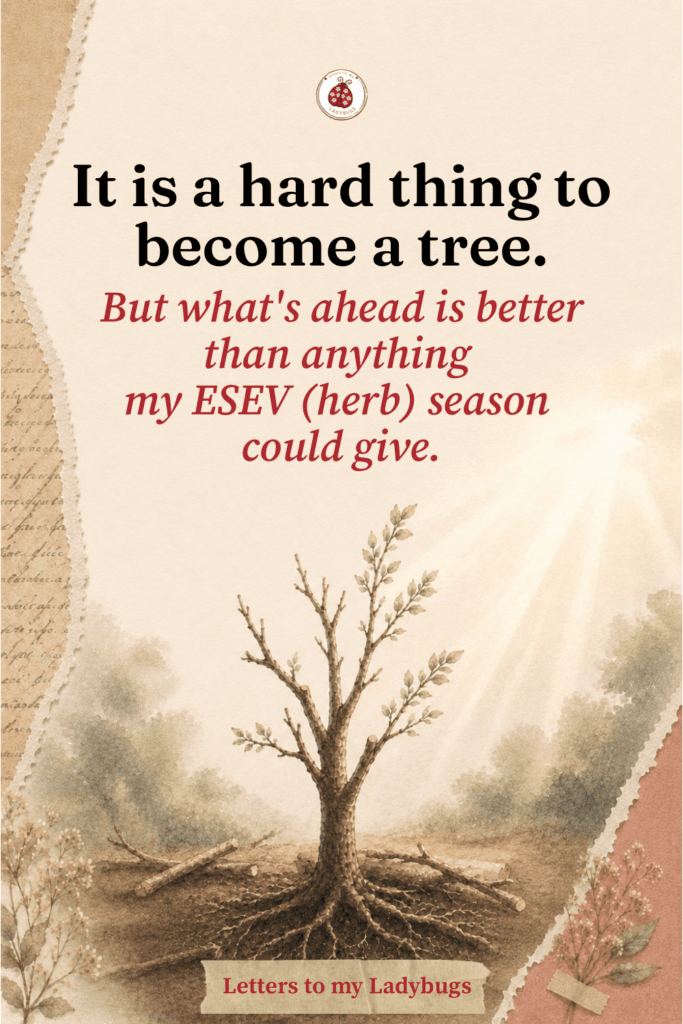
It is a hard thing to become a tree. But the promises are better than the ones ESEV could ever have kept.
ETZ, the tree
And then I stopped being ESEV because God is now calling me to be an Etz.
In the old pictures, it’s written 𐤏𐤑 — an eye, seeing. A hand, reaching to catch, to pursue. Put together, they picture something seen — and chased after, the way a hand closes around what it has no intention of letting go.
That’s me. Seen and pursued by a loving Father.
That’s you too, Ladybugs. Not hidden, not overlooked, not one of God’s “other matured kids” I used to think He was too busy for. Seen. And pursued, the way a fisherman pursues a catch he refuses to lose.
David knew this tree. In Psalm 1, one of the psalms I try to live by, he said the blessed man is like a tree planted by rivers of water — not a tree that found its own water, not a tree that dug its own well. Planted there. On purpose, by someone else’s hand, next to a source it didn’t create and can’t control. That’s the same dependence I had as ESEV — except now it’s not fragile dependence, watching the sky for a storm I couldn’t predict. It’s rooted dependence. The kind that doesn’t wither, because it’s finally drawing from the right river.
Trees show up again in the New Testament, and not gently. Jesus once cursed a fig tree — not for lacking leaves, it was lavish with those, full and green and impressive to look at. He cursed it for having no fruit. “You will know them by their fruits,” He said elsewhere, and I used to hear that as a warning about other people. I don’t anymore. Leaves are easy. Leaves are how a tree looks like it’s thriving. Fruit is the only thing that proves it actually is.
And in Galatians, Paul doesn’t say we should try harder to display love, joy, peace, patience, kindness. He says we produce them — the way a tree produces fruit, not because it’s straining, but because that’s simply what a healthy tree does, once it’s actually rooted.
Genesis says it plainly, too: “fruit tree, yielding fruit.” Not a tree that might, eventually, someday, get around to it. Fruit is already inside the name. Already inside the identity. Before the tree ever bears a single one, the fruit is already who it is — it’s just waiting to be seen.
Here is the part I don’t think I understood until this letter, Ladybugs. Jesus carried a tree up a hill. Dry. Dead. Wood with no leaves and no fruit and no life left in it at all. And He let His blood fall onto it.
Jesus carried a tree up a hill… and He let His blood fall onto it. Not near it. Onto it.
That tree lives until now.
Because we are that tree.
Every ETZ that has ever been planted by the river, every fig tree that ever got the chance to try again after being cursed for its leaves, every fruit that was ever named before it was grown — all of it is that same wood, still standing, still soaked in the blood that was shed directly onto it. Not near it. Onto it.
I am not ashamed to still be growing roots in the dark. I am not ashamed of the branches that had to be cut. Because the tree I am becoming was already covered in blood before I bore a single fruit — which means I don’t have to earn what’s already true about me. I only have to bear it. Bear the fruit first. Then scatter the seed.
Bear the fruit first. Then scatter the seed.
Here’s what I didn’t expect to learn, writing this: the seed was never separate from the fruit. Genesis says it plainly — “fruit tree, yielding fruit, whose seed is in itself.” The seed doesn’t arrive after the fruit. It was already there, the whole time, waiting inside.
Which means bearing fruit isn’t the goal. It’s the doorway. We bear fruit first — patience, kindness, gentleness, self-control, the fruits Galatians names — not because fruit is the finish line, but because the seed for someone else’s whole life is hidden inside it, and it can’t be reached any other way.
I am not good at this yet, Ladybugs. I’ll tell you honestly: patience alone is a daily fight with the two of you. Some days I lose it before breakfast is even finished. But I’ve started to understand that every one of those hard moments is actually an opportunity — God handing me chance after chance to practice bearing what I’m asking Him to grow in me. And I’ve learned to trust that He doesn’t just hand me the opportunity and walk away. He’s there in it, like an artisan shaping the branches of His own tree, patient with the pruning because He can already see the shape He’s making.
One day — I don’t know exactly when, but I trust the season — the fruit will be ready. Someone will taste it. Maybe it’s you. Maybe it’s this blog. Maybe it’s something else entirely. And when they do, they won’t just be tasting something sweet. They’ll find the seed inside, the part of the fruit that was never meant to stay in one place.
That seed will scatter. It will land somewhere I’ll probably never see — in someone else’s life, someone else’s grief, someone else’s rooftop prayer — and it will grow into its own tree. New people, gathering their own small moments as proof of His faithfulness. New people, writing their own praises. New people, becoming DESHE and ESEV and ETZ in their own gardens, having no idea their seed came from a fruit I was too scared, once, to even plant.
That’s the part I’m actually pregnant with, I think. Not just the blog. The seed inside whatever the blog becomes — the part of this that was never going to stay mine.
I told you both, at the start of this letter, about two dreams, and I know now why I dreamed them. I was pregnant before I had words for it. God let me carry the truth of what I was becoming in my sleep, long before I was ready to hear it plainly, awake, in a Bible verse about grass and herbs and trees.
But here’s what I keep coming back to, out of everything this Creation series has shown me so far: in that second dream, I was crowning. There was no pain.
That’s not how it usually goes, is it? I know what labor is supposed to feel like — I’ve done it twice, with the two of you. But God let me dream the one part of this that should have hurt the most, and let it come without pain. Not because the labor up to that point hasn’t cost me anything. It has hurt. I’m not pretending otherwise.
But I am not afraid of what’s still coming. You will not always know how long the labor lasts. But you can know, the way I know now, that when it’s time to crown — when the thing God’s been growing in you finally has to come out into the light — it does not have to come with fear attached.
I am still pregnant, my ladybugs. I am still waiting. I don’t know if the fruit is nine months away or a year or longer than that. I told you already — I’m not rushing it. Elephants take longer than dogs, and I happen to think God is growing something enormous in me. And I would love nothing more than for you to be there when whatever this is finally arrives.