
My sweet ladybug,
Happy birthday! I cannot give you something huge this year, but there’s something huge in a different form, here for you.
You will remember this story as something I told you as a bedtime tale — condensed and a little filtered. But I always knew this day would come, when you’d find this and read it as it truly was.
I want you to know, first, that your faith has made me stronger. Your faith is a testimony, my love.
“Your faith has made me stronger. Your faith is a testimony, my love.”
I’ve watched your faith turn rainy days into sunny ones, simply because you prayed to go to the beach. I’ve watched you pray for things to turn around in your favor, and watched them turn. And now, your faith is showing me how real God is, and how deeply He loves you.
You’ve had questions I wished I could answer, but you were too young, then, to carry those answers — so I turned them into a story instead. Now that you’ve found this, this is the answer, love.
The Wise Man is wise. He is never wrong. He is gracious and full of love — and without Him, this story would not be beautiful at all.
I want you to remember always: He loves you. And I am endlessly grateful that He showed me that — and that He gives you everything, far more than I ever could on my own.
So here it is, whole this time — the story I once gave you only in pieces.
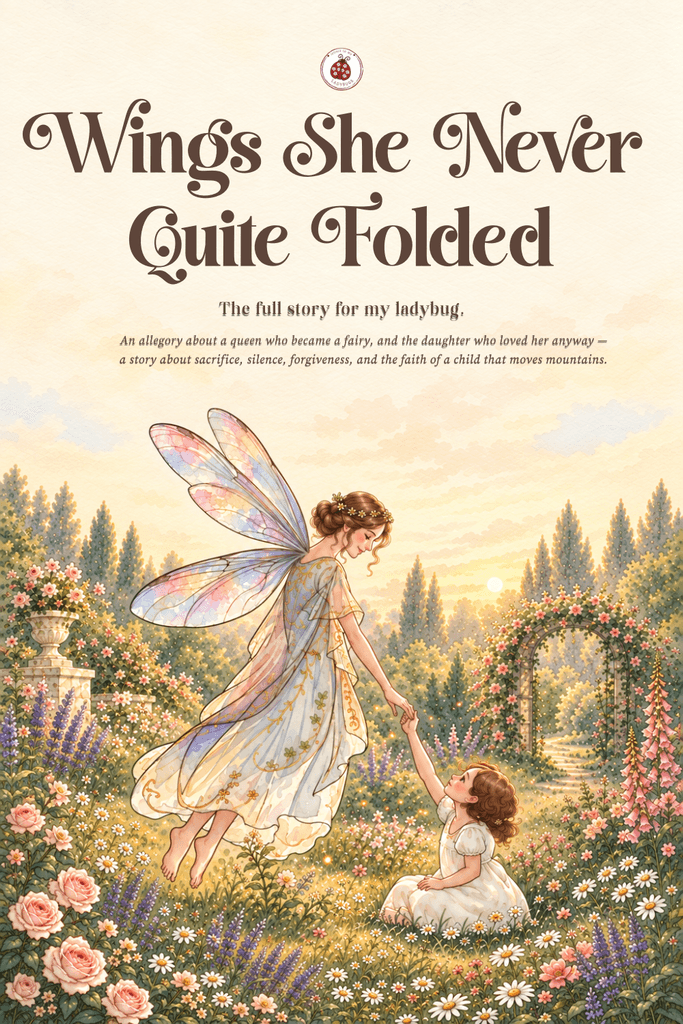
This is not really a story about kingdoms, or fairies, or wings. At its heart, it is a story about faith and forgiveness. You will know that by the time you reach the end, my love — if you don’t know it already.
It begins, like most true things do, with a kingdom that was small, ordinary and happy in the particular way ordinary things are happy, before anyone teaches you to want more than that.
There was a king who loved loud music, and built things with his hands. A queen who carried fire in her chest and never once let her children see her tired. A little prince who, though eccentric, was as skilled as the king at building, and a little princess who watched everything — the way some children do — long before she had the words to ask about any of it.
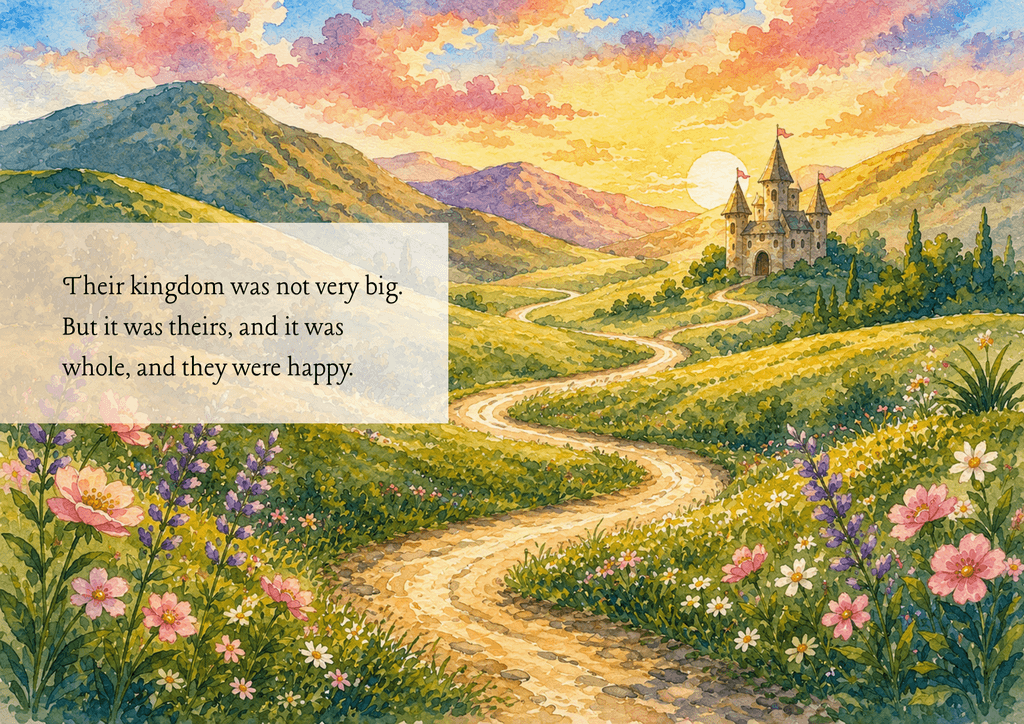
Their kingdom was not rich. But it was theirs, and it was whole. It was simple, but there the royal children found every trace of love in the smallest things. Their castle was clean, their little garden blooming with hanging orchids and climbing roses and various trees. But it was beyond beautiful.
But then the monsters came.
Not the kind with teeth, though it would take years for the princess to understand that. The kind that come quietly, in empty granaries and unpaid debts, in a king who goes still with pride mixed with grief and a queen who cannot bear to watch her children go hungry.
This is where the story really begins — not with happily ever after, but with a choice nobody in that small kingdom wanted to make.
The queen, disappointed and anxious, thought that the only way she could survive this and secure her children was to become a fairy. But becoming a fairy is not that simple, and everyone knew that. She would be able to fly back to her family, but little by little, she would transform into something different. Some were able to return, but most came back as something else entirely. The princess was scared when she heard the tales. The queen knew about them, but she vowed to be different, and she dismissed them as myths. The king, however, knew just as clearly as the queen that the tales were true, but unlike her, he did not dismiss them.
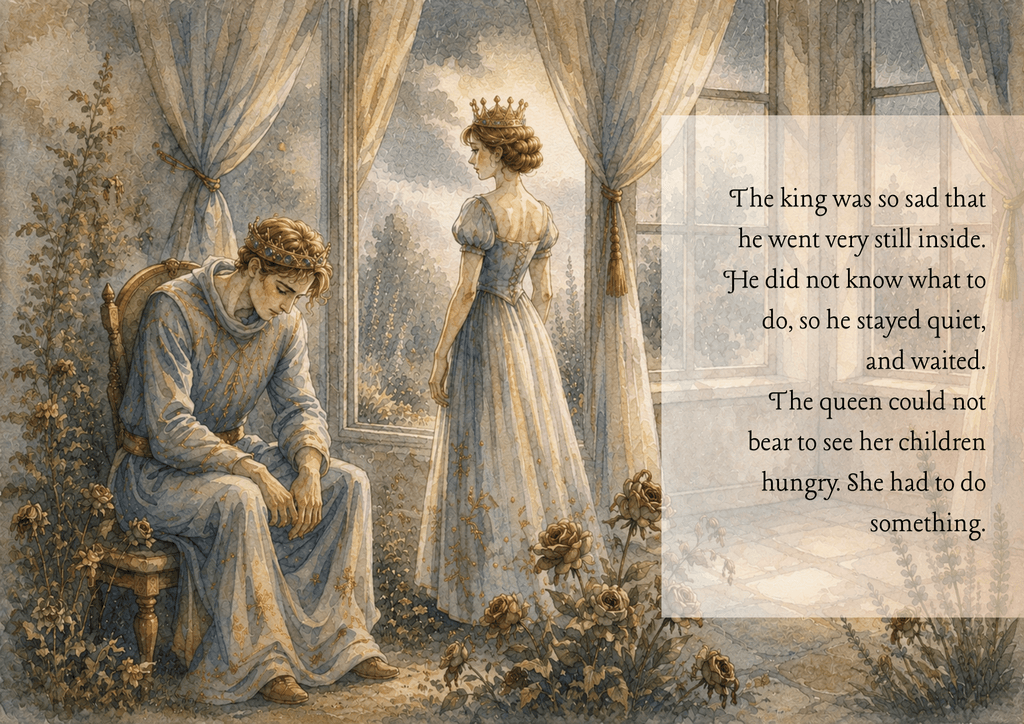
The king found the queen the night before she left, sitting awake by the dying fire.
“If you do this,” he warned, “you will not return to this kingdom as its queen. Whatever you become out there — it will not be what you are now.”
She already knew. It broke her heart, but she chose to go anyway.
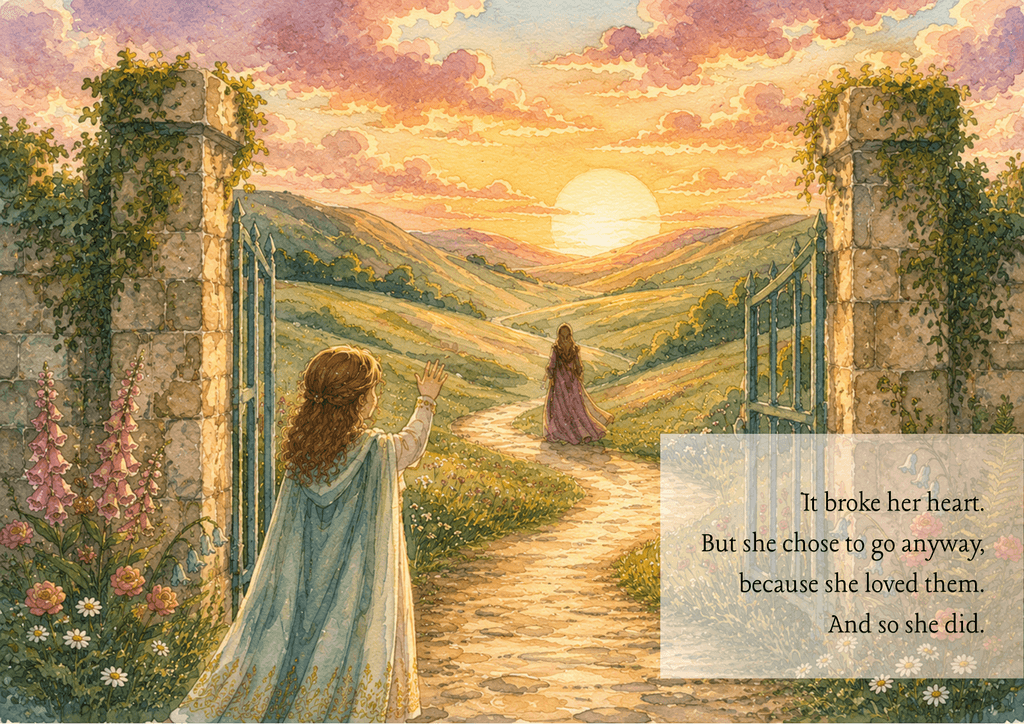
The princess, too young to understand sacrifice, only understood absence, and she hated him for it at first — hated him for letting her mother walk away, for saying nothing to stop her, for staying so still in his grief. At the same time, she had no one left standing upright beside her. It would be years before she understood that he had not been doing nothing. He had been doing the only thing he knew how to do with a grief that large: surviving it, quietly, so there would be a kingdom left to come home to.
The princess cried every night for almost two months.
Slowly, the crops grew back. The livestock returned, one by one. But the monsters never fully left — they only grew quieter, the way monsters do when they’re waiting. And so the princess had to learn to fight them herself, and a Wise Man came to teach her how.
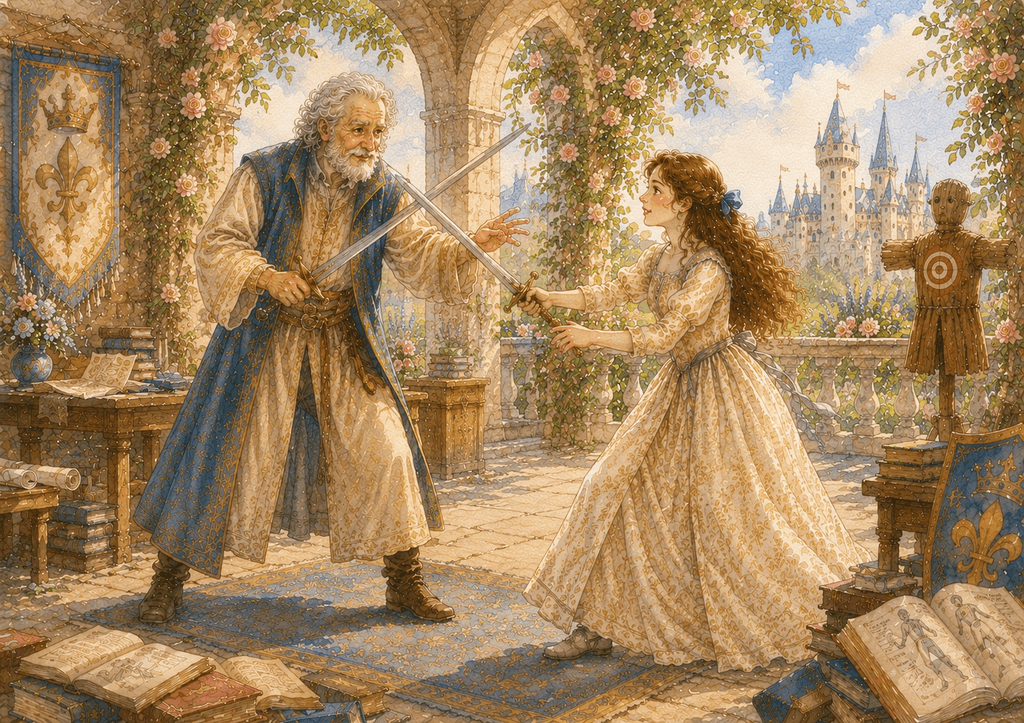
Not all His lessons were gentle. “Some of these monsters,” He told her, “live inside you. You will have to kill those first, before any armor will fit.”
“Some of these monsters live inside you. You will have to kill those first, before any armor will fit.”
One day, the princess brought Him a question she had carried for a long time—the kind that grows heavier the longer you hold it without asking.
She found Him in the late afternoon, when the light was going gold.
“My mother is a fairy now,” she said. “And the monsters are still here.”
The Wise Man looked at her the way He looked at everyone who came to Him with the questions that mattered — fully, without hurry.
“In this world,” He told her, “the monsters will always come. But be of good cheer. I have overcome this world.“
She thought about that. Then, because she was the kind of child who always asked the next question: “Then why did you not help our kingdom when they came? We needed you. We needed you, and you did not come.”
He did not flinch from it. He never flinched from the honest ones.
“He did not flinch from it. He never flinched from the honest ones.”
“I was already fighting for you,” He said, “long before the monsters arrived. Your king and your queen — they knew of me. They asked for my help, in their way. But they did not trust my wisdom enough to let me lead. They wanted help on their own terms.” He paused. “And the monsters came anyway.”
The princess was very quiet.
“I am not telling you this to blame them,” He said gently. “I am telling you because I am asking you the same thing I asked them. Will you trust me — not only when the kingdom is whole, but when the granaries are empty, and the king goes still, and the queen puts on her traveling cape? Will you trust me then?”
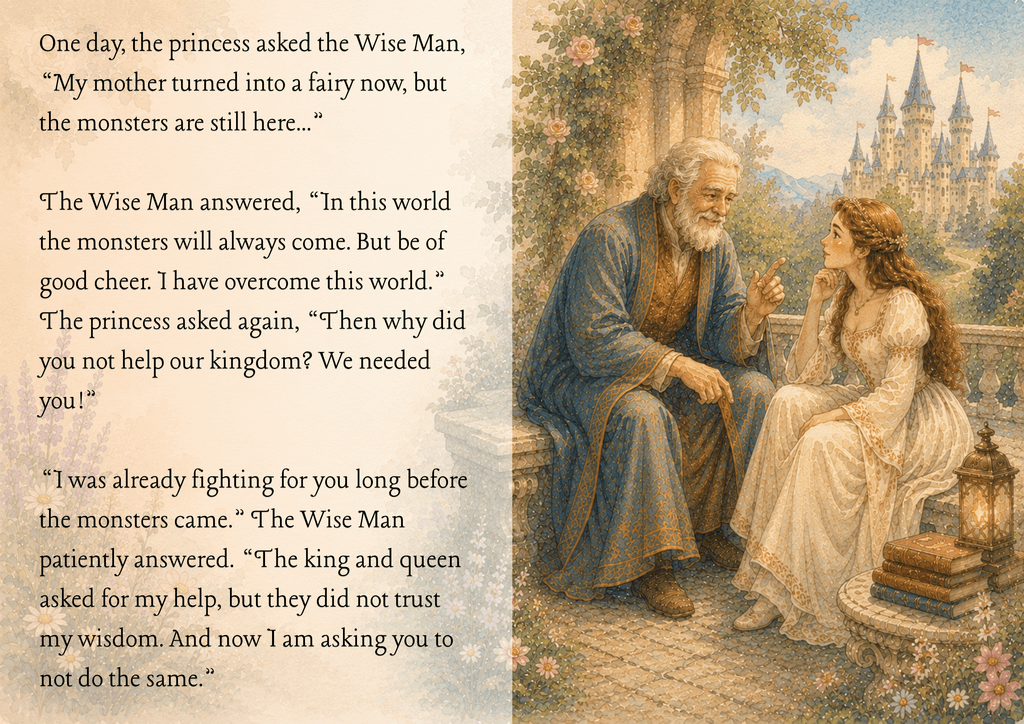
She didn’t answer right away. She was young, and the question was enormous.
But she nodded. And He smiled.
She did not fully understand what she had agreed to. She would, later — more times than she wanted to, and more times than she could count.
The queen came home sometimes, and when she did, she came as someone slightly less the woman who had left.
The first time the princess noticed, she almost didn’t believe it. The fairy had landed in the garden — or so it seemed. But her feet stayed just above the grass, hovering the width of a coin, swaying when the wind blew like a kite tethered loosely to the ground.
“Sit with me,” the princess said, patting the dirt beside her.
The fairy folded herself down, but her wings stayed open behind her, twitching now and then, as if impatient to be used.
“Your dress will get muddy,” the fairy said, frowning at the garden bed.
“I don’t mind,” said the princess.
“I used to mind everything,” the fairy said, and there was something in her voice the princess didn’t have a name for yet — not quite sadness, not quite pride. “Do you know what I have carried, flying back and forth between kingdoms? You would not believe the things I have seen. The things I have survived, alone.”
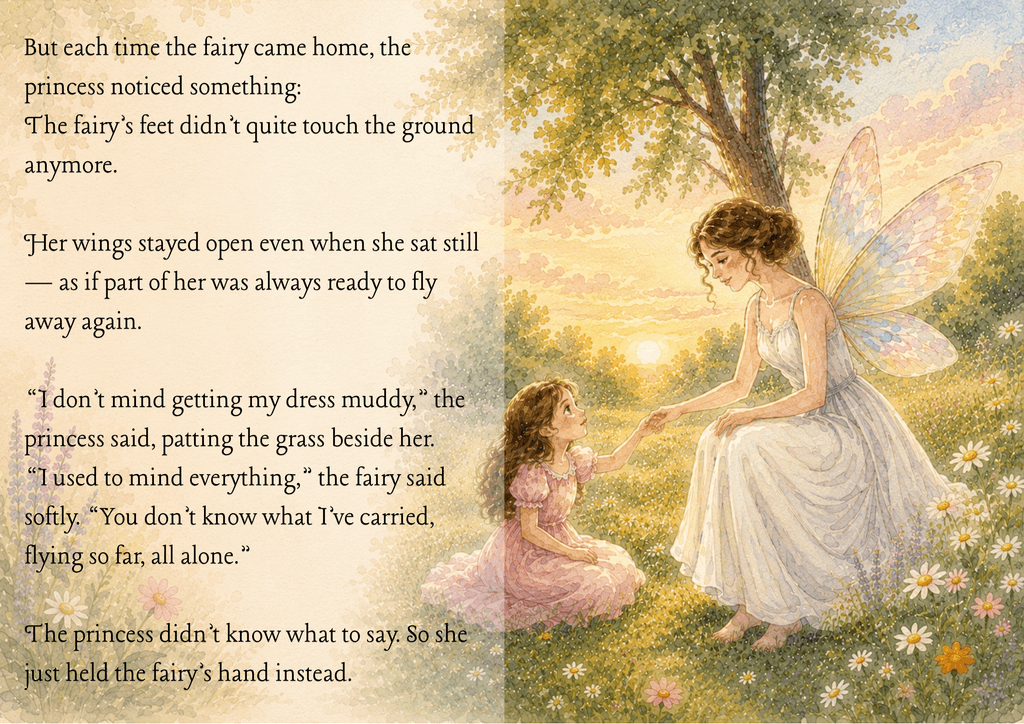
The princess wanted to say, “But we were alone too.” She only knew how to love, not yet how to argue, so she said nothing and reached for the fairy’s hand instead.
The fairy let her hold it. But her wings did not fold. And when she finally flew off that evening, the princess noticed she didn’t look back at the kingdom — she looked up, toward the next sky.
Years moved the way years do, all at once and not at all.
The princess grew, married a kind and steady king, and became a queen of her own small kingdom — one she chose, deliberately, to build on a different foundation than the one she’d grown up watching. Love, not order. Grace, not earning.
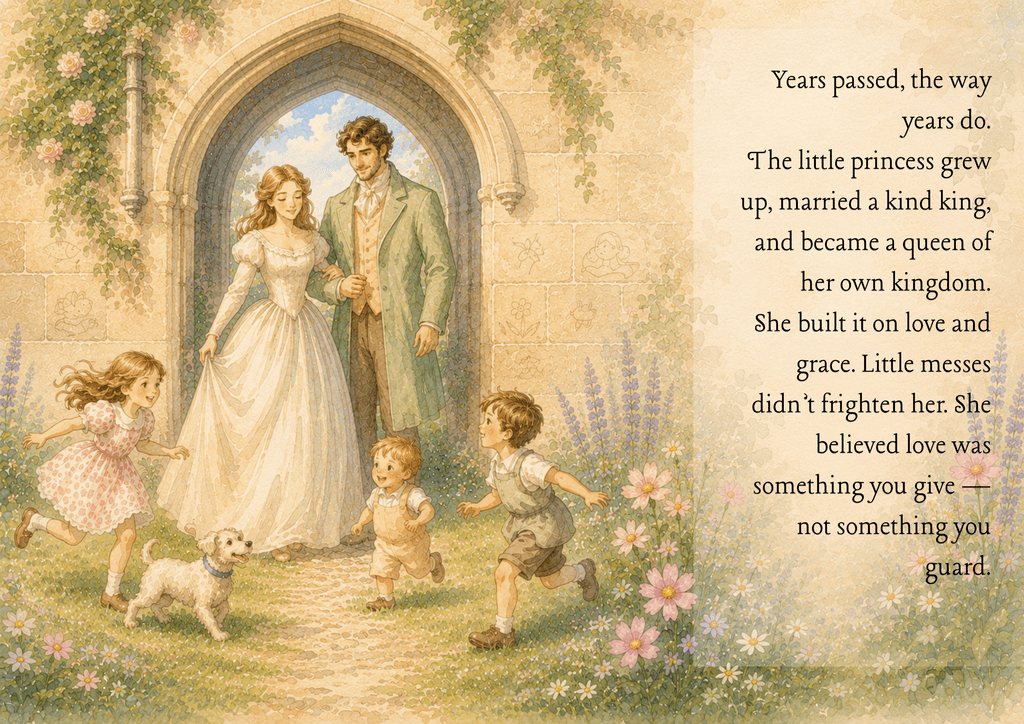
When her own children left charcoal suns on the nursery walls, she pinned them up like crown jewels instead of scrubbing them clean. And on ordinary afternoons like this one, she let the garden be exactly what it was.
The children had come in from playing without stopping to wash. They were soiled and sweaty, leaves still caught in their hair, their clothes carrying the full evidence of an afternoon well spent. They settled into the grass without ceremony and reached into a basket of biscuits with muddy hands — all of them, the little princess, the little prince, and the servant’s daughter right in the middle of them, no different from the rest, her laugh just as loud, her hands just as muddy, reaching for the same biscuits from the same basket. The dog had stationed himself at the edge of the circle, tail wagging with great optimism. A pair of chickens wandered over to investigate the crumbs falling on the grass, unbothered and uninvited and very much present.
The new queen stood in the doorway and felt nothing but warmth.
The fairy appeared beside her, and her eyes moved slowly across the scene — the unwashed hands, the soiled clothes, the muddy seats, the animals threading through the edges of the meal — and settled, for just a moment longer, on the servant’s daughter, sitting in the center of it all, eating the same food, treated as no different from the children of the house.
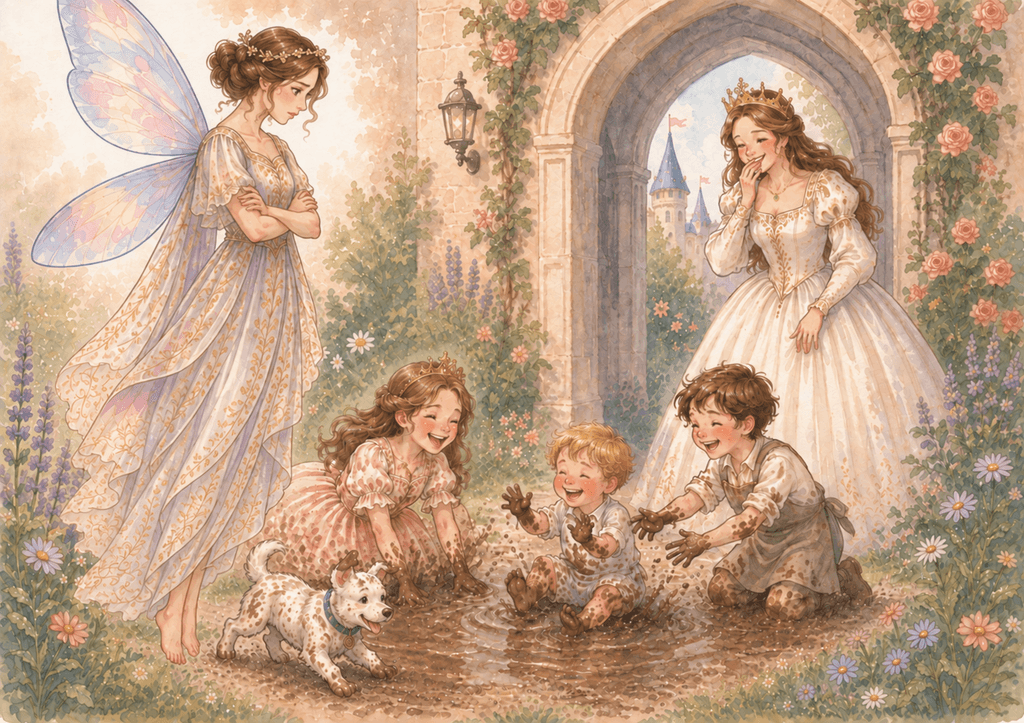
Her expression did not change exactly. But something in it gathered.
All of it. Not one thing — all of it.
“This would not have happened in my kingdom,” she said.
The new queen looked at the same scene — the muddy hands, the wagging tail, the crumbs on the grass, the servant’s daughter laughing with her children — and saw nothing that needed correcting.
“I know,” she said gently. “This is a different kingdom.”
“There is no order here. No one teaches these children what belongs to whom, what is precious, what should be kept clean.” Her voice rose, just slightly. “I worked too hard, gave up too much, for things to be this… loose.”
The new queen wanted to say it is not loose; it is loved. But she had learned, slowly and painfully, that being right and being kind do not always arrive in the same sentence — so she chose only one. “I’m sorry you see it that way,” she said. “But I will not raise them on fear of a stain.”
“Being right and being kind do not always arrive in the same sentence.”
The fairy did not answer. She looked at the charcoal sun on the wall for a long moment, then turned, and her wings caught the wind before her feet ever left the floor.
Neither of them spoke of it again. Not that week. Not that month.
“The silence grew the way weeds do — not all at once, but in the spaces nobody tended.”
Every morning after that, the new queen sent a butterfly across the sky, carrying a small folded note: I love you. Come back to us. She sent one in spring. She sent one in the rains. She sent one when the leaves turned gold.
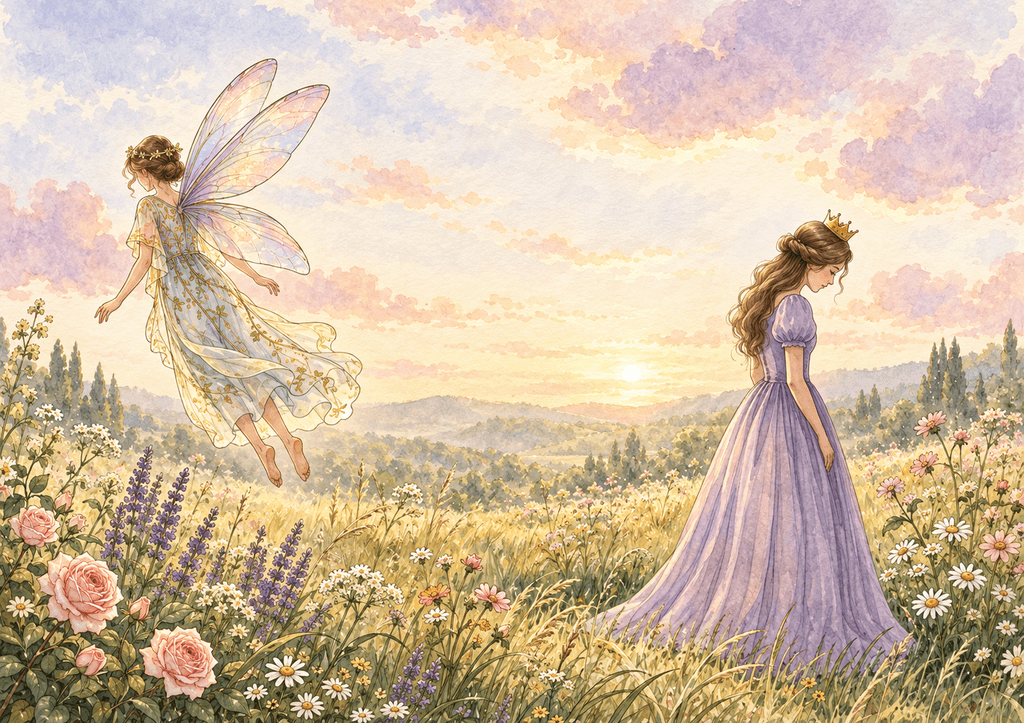
Not one butterfly returned.
Then, one evening, a traveling merchant mentioned — carelessly, the way people mention things that aren’t theirs to carry — that the fairy had been telling stories in faraway kingdoms. Stories about the new queen that were not true, twisted small as a coin until they looked like something else entirely.
The new queen did not sleep that night.
In her hurt, words came out of her that she wished she could call back the moment they left her mouth: Let her eat her own anger, then, since she will not eat at my table.
The hurt did not stay only in her heart. It moved into her body — she grew tired in a way sleep could not fix, and thin in a way food could not fix, until even the children noticed their mother had grown quiet.
She went to the Wise Man, not for an answer this time, but because she had nowhere else left to go.
“I don’t understand her,” she wept. “I don’t understand why she would do this.”
“You do not need to understand her,” the Wise Man said. “You only need to forgive her. Understanding is not always given. Forgiveness is always a choice.”
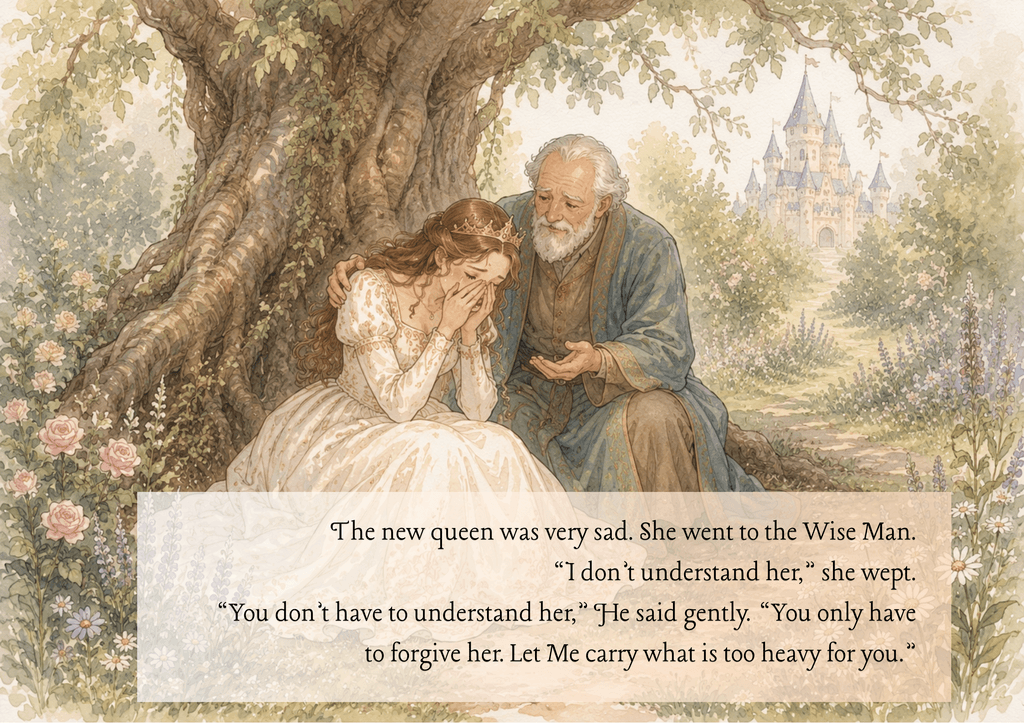
“You do not need to understand her. You only need to forgive her.”
“But I am so tired.”
“I know,” He said. “So let Me carry what you cannot, and build your strength on what I have already done — not on what she has not yet done.”
She did not know, while she was learning to forgive one wound, that she was quietly growing another.
The new queen built her own small treasury, coin by coin, without telling anyone why it mattered so much to her. It wasn’t greed. It was memory. Somewhere in her, a much younger princess remembered watching a queen leave because a kingdom had no gold left, and she had promised herself, without ever saying it aloud: I will never be caught with empty hands again, lest I be forced one day to become a fairy too.
So she worked. She worked even when she was tired. She worked even when the prince and princess asked her to come sit in the garden, and she said “soon” too many times to count.
The anger crept in slowly, the way smoke fills a room before anyone smells fire. She grew short with the children. She grew shorter still with the old king, who only ever asked, gently, if she might rest.
“You don’t understand,” she told him once, sharper than she meant to be. “You were never the one who had to carry a whole kingdom alone.”
Her body began to fail her too — the same tiredness that would not lift, the same thinness no feast could fix.
One night, the Wise Man gave her a dream.
In it, she was small again, standing in a crumbling palace, watching gold slip through her own small fingers no matter how tightly she closed her fist. Behind her, holding her hand, were her own son and daughter — and she realized, with cold and terrible clarity, that she was leading them backward, into the very same fear she had spent her whole life trying to outrun.
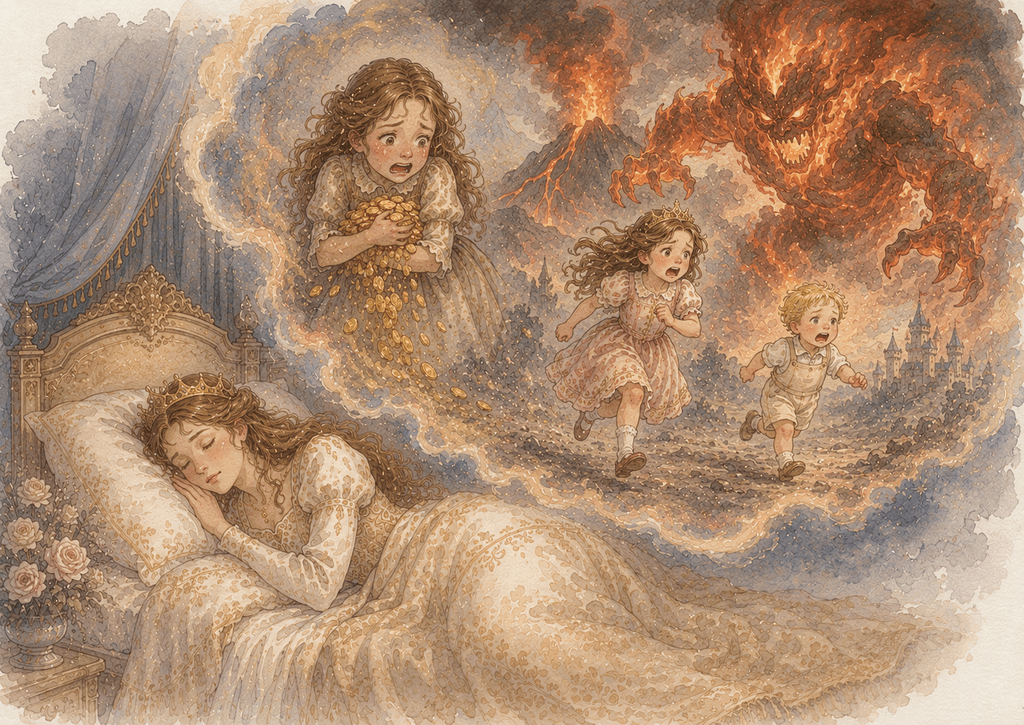
She woke with tears already on her face.
“You are dragging them to the place of your wound,” the Wise Man told her, “and calling it protection.”
“You are dragging them to the place of your wound, and calling it protection.”
“I don’t know how to stop.”
“Then start with this,” He said. “Forgive the old king for what he could not give you. And ask forgiveness for what you have not yet given him — patience, trust, a daughter’s grace.”
It was not easy. Some days her pride fought her the whole way there. It cost her more than she had words for — years of a different kind of anger, a different kind of grief — but little by little, she let go of the coins clenched in her fist, and reached instead for the old king’s hand. He took it without a single word of blame.
Letting go was not one decision. It was a thousand small ones.
It meant trusting that the king beside her — capable, steady, an anchor where she had only ever known shifting ground — could hold what she had once believed only she could carry. It meant remembering that she had grown up watching queens become fairies, some who flew back, some who never did, and fearing, quietly, that she might be one more name added to that pattern if she ever loosened her grip.
“I am not asking you to disappear,” the Wise Man told her. “I am asking you to stop ruling the kingdom alone, as if you were still that frightened princess with no one beside her. You are not alone now. I gave you a king with wisdom enough, and resources enough, to keep this kingdom standing. Will you trust what I have given you, or only what you can hold in your own two hands?”
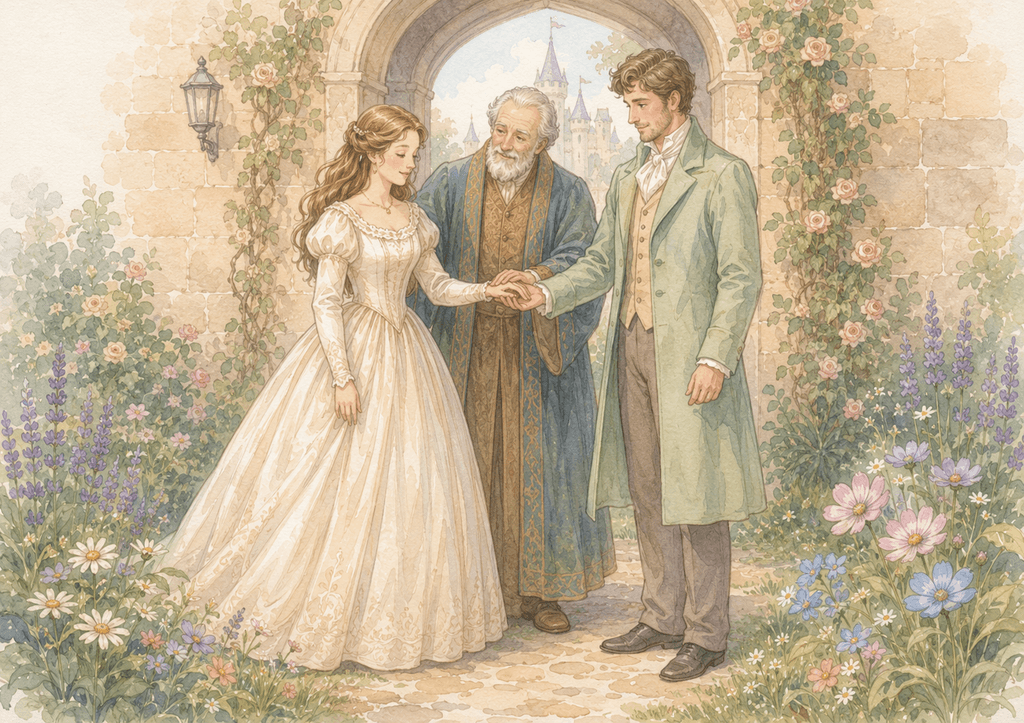
“I am not asking you to disappear. I am asking you to stop ruling the kingdom alone.”
It cost her something to answer. Pride does not leave quietly, and old fears do not unclench on command. But day by day, the new queen set down her own small treasury — not because gold no longer mattered, but because she finally believed she was not the only one keeping the kingdom from falling.
“Pride does not leave quietly, and old fears do not unclench on command.”
Slowly, she became a gracious queen instead of a co-ruling one. And the kingdom did not fall. It grew.
Time carried the little princess to her seventh birthday, and the Wise Man, who loved her especially, asked her to make a wish — promising that faith could carry it home.
The little princess wished to see the fairy again.
When the new queen heard it, she wept — not where her daughter could see, but later, alone, where mothers keep the tears they don’t want their children to carry.
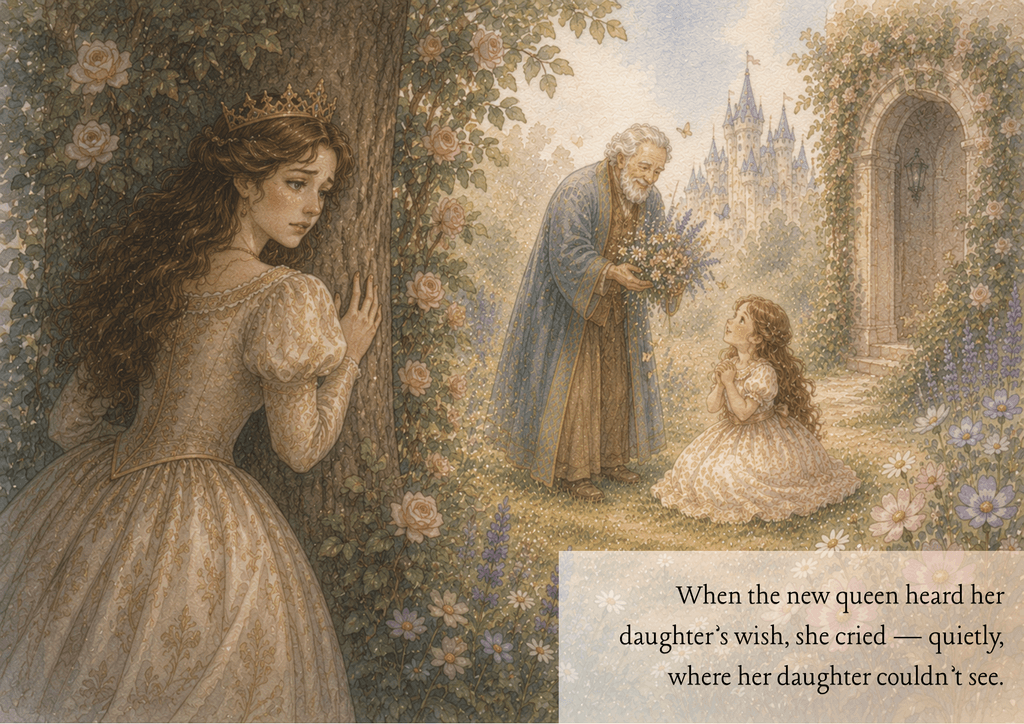
It was not only sadness. There was a sting she could not quite name — the particular ache of wanting to give your child every good thing, and knowing this one thing was not yours to give. She knew what it was to hope. She knew, too, what it was to hope and watch the wish not come. And some nights, that was the only prayer she had left: please, not for her. Let her not learn what I learned, the hard way, about wishes that don’t arrive.
Her own wounds, though healing, still opened sometimes without warning — old enough to have a scar, fresh enough to still bleed — and on those nights she returned, again and again, to the same hands that had healed her before.
But she also knew something her own fear kept trying to make her forget: the Wise Man had a particular tenderness for this little one. What the new queen could not make happen by wishing, working, or willing it into being, He could.
So she did the only thing left that was fully hers to do.
She let her daughter hope, even though her own heart had grown careful with hoping — the kind of careful that comes only from having hoped before, and having watched the wish not arrive. Her heart still ached for what her daughter wanted. But her trust no longer rested in wishes, or in wings, or even in her own two hands.
It rested in the Wise Man, who makes impossible things possible.
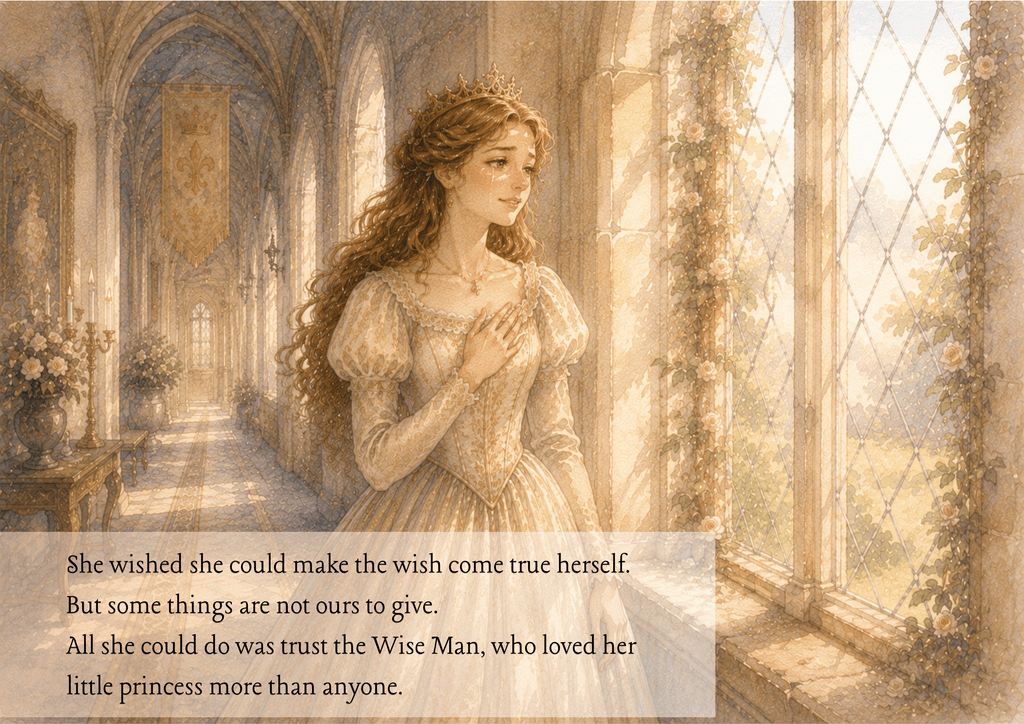
And in a little girl with faith enough to move mountains, and call down wind enough to carry a fairy home.
“Faith enough to command the wind,” the new queen said, with a tired, watery laugh, “while I can barely command myself not to cry.”
“Faith enough to command the wind, while I can barely command myself not to cry.”
The Wise Man smiled at her — not unkindly, the way one smiles at someone who has just told the truth without meaning to.
“I have heard you,” He said.
“I have heard you.”
And He had.
The fairy came.
She arrived the way fairies do — briefly, and with her wings still open, already angled toward the next sky. But she came. The princess’s wish had found her across however many kingdoms, and however many miles, and something in it had been strong enough to change her direction, if only for a little while.
The new queen watched it happen from a careful distance.
She had prepared her heart for it this time — not with hope exactly, the way she used to hope, reaching and aching and counting the days. With something quieter. An acceptance that the fairy was a fairy now, fully and completely, and that the woman who used to touch the ground and sit in the garden and let her dress get muddy was gone in the way that some people go — not to death, but to a version of themselves that doesn’t come back.
She had made her peace with it.
What she had not prepared for was this: watching her daughter’s face when the fairy arrived.
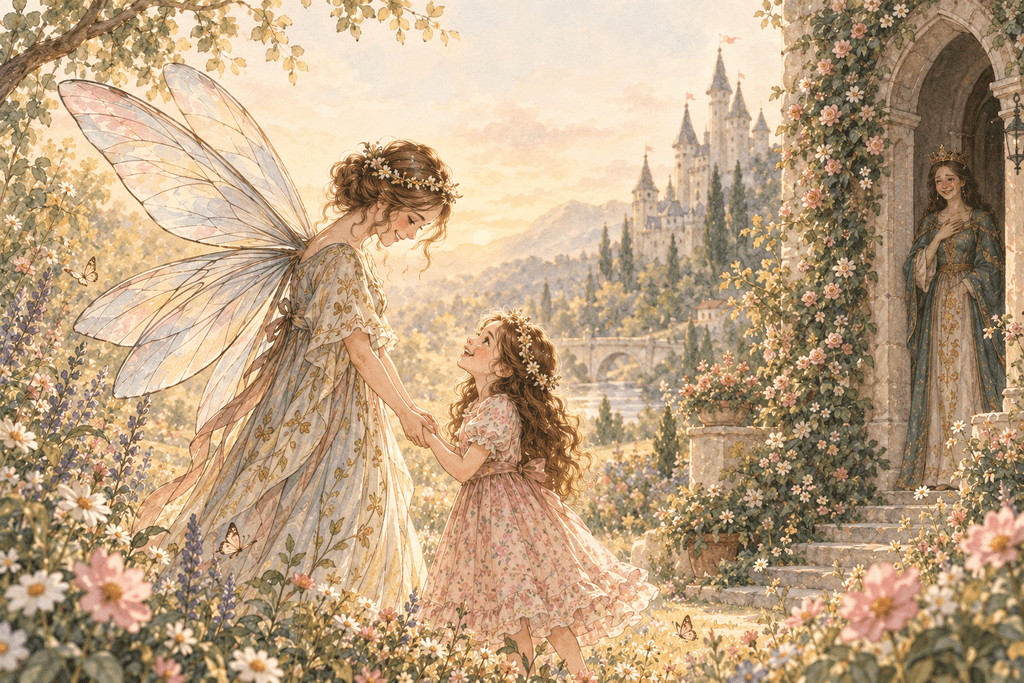
The new queen did not have words for what she felt standing in that doorway. It was not the happiness she had once imagined for this moment, the kind she used to rehearse in her head where everything was restored and healed and whole. It was something smaller and more holy than that. A witnessing. She had been allowed to stand in the room while a child’s faith — uncomplicated, unguarded, the kind that doesn’t know yet to protect itself — reached across an impossible distance and moved something.
She thought: so this is what He does with the prayers I cannot pray anymore. He gives them to her instead.
When the fairy left again, the new queen did not chase her.
She stood at the gate and watched the wings catch the wind, and she felt, underneath the ache that never fully goes away, something she had not expected.
Gratitude.
Not for the ending she had wanted. For the one the Wise Man gave her daughter instead.
She touched her own chest, where the old wound lived, and she said — quietly, to no one in particular, or perhaps to the only One who was always listening:
Thank you for loving her better than I know how.
“Thank you for loving her better than I know how.”
And she meant it.