
Waters. The void. The vast nothingness now exposed in the light of God.
Genesis 1:7 And God made the firmament, and divided the waters which were under the firmament from the waters which were above the firmament: and it was so.
When we read Genesis 1, we often skip the words and take them literally, with a little sprinkle of imagination. But recently, God has been highlighting a word to me here and there, and it just blows my mind.
On Day 1, He named my darkness so I could finally tell it apart from Him. I thought that was the hard part — seeing clearly. I didn’t know yet that Day 2 would ask something harder: not just seeing what’s not Him, but choosing to move toward what is. Naming got me clarity. This is asking for obedience.
In the KJV, God divided the waters. The word is bādal, and it mainly means to divide, to separate — but not like cutting something in half. It means to set apart, to make a distinction, to withdraw from and separate unto. Another word for being set apart is “holy.” God separated water from itself, from what was already there, and set it higher.
I don’t know if you get it yet, kiddo, but I pray the Holy Spirit reveals this to you the way He did to me: set yourself apart, and be among the water that was placed above. (Water, by the way, isn’t only water in scripture — it’s used again and again for peoples, multitudes, nations. So when I say “be the water placed above,” I don’t mean it poetically. I mean it about you, about us, about the people we choose to stand with.)
I know it is hard to be set apart. It means turning your back on worldly thinking, worldly opinion, worldly standards. You will be called weird, a bore, a sucker, maybe worse. I know because I’ve lived it — the small ways first. I stopped stressing over dirt on the floor, over keeping the sofa cover safe from your muddy feet, because I decided those things weren’t as important as bearing the fruit of the Spirit: kindness, joy even in chaos, goodness, patience.
Someone I deeply love didn’t see it that way. To her, those small things mattered — a lot, I think, more than I understood at the time. I held on to what I believed mattered more, and she didn’t like it. I lost her over it. I am still grieving that loss, even now.
Even Jesus said He did not come to bring peace but a sword (Matthew 10:34–36) — separating truth from falsehood, kingdom allegiance from worldly allegiance. If you choose to follow Him and the people around you won’t, He will still sever it, even if it’s someone you love. I know that firsthand.
But God will never set you apart without something to hold you up.
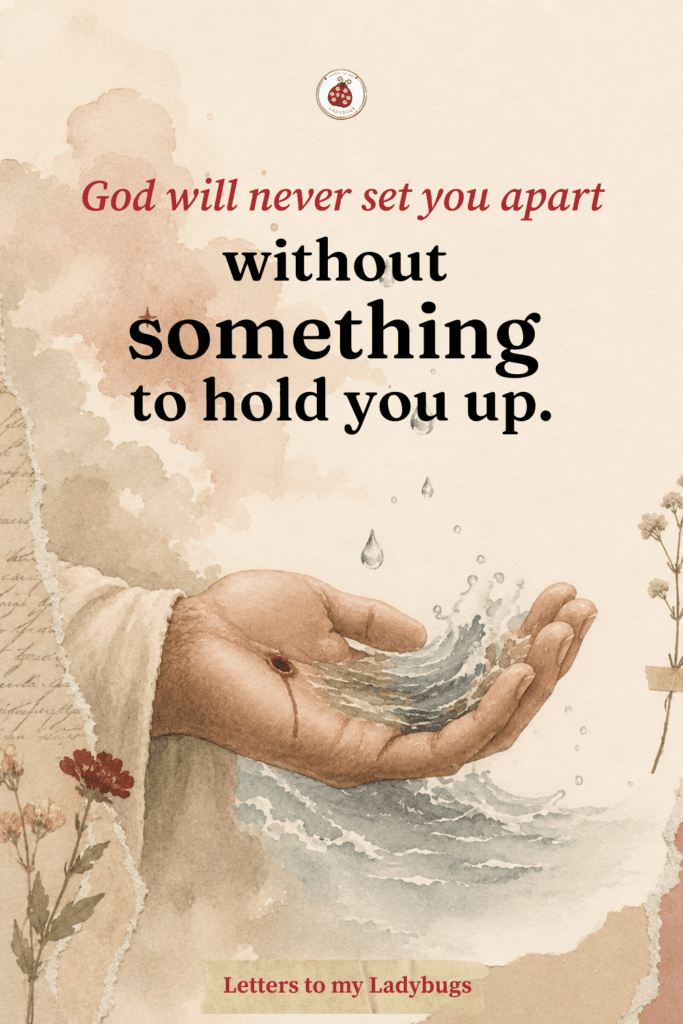
And that’s the firmament.
The original Hebrew word is raqia, written 𐤓𐤒𐤉𐤏 — a head, a sun on the horizon, a hand, an eye. To me it reads like a dwelling place — where the head of something works and watches over it. Its root, raqa, means to spread out, to hammer, to beat — the way metal is beaten into shape. The firmament isn’t just a ceiling. It’s the thing that holds the set-apart water together — spread out, hammered, beaten to bear the weight of it.
Does that sound familiar?
If we’re the water set apart and placed above, who do you think was spread out and beaten to carry the weight of us? Does the Lamb slain from the foundation of the world make more sense now? It does to me.
There’s one more word I found — tamak, written 𐤕𐤌𐤊: tav, drawn like a cross — covenant, a sign, completion. Mem — waters, chaos, the masses. Kaf — an open hand, to hold, to contain. Together: a covenant, marked by a cross, holding the waters together. A hand ready to hold you once you’re set apart. David sang it in Psalm 63, in the wilderness of Judah:
My soul follows close behind You; Your right hand upholds (tamak) me.
Before the Word ever lit up the void, He had already agreed to become a lamb slain as the world was founded. He knew the cost of holding us up, and He created anyway — knowing that one day, His children would sin, would leave, and would still come back to find Him already there, holding them up the whole time.
I won’t pretend the ache is gone. Some nights it still finds me. But I know now that even while I couldn’t see Him, He was already there — hammered, spread out, holding up the water I didn’t yet know how to let Him hold. It took me time to stop fighting the hand and just rest in it.
Looking back now, I can see it clearly: the drama, the pain, the illness it triggered, the trouble at work that followed, and then the quitting — all of it led me here. To this page, talking to you, mind-blown by what God keeps revealing. I wouldn’t be here without any of it.
I don’t believe God causes strife, my ladybug. He is not the author of chaos. But He can allow what strife breaks to become the very thing that carries you somewhere strife could never take you on its own. I still wish it had come a gentler way. But I’m no longer asking God to undo it — only to keep showing me what it was for.
But I’m no longer asking God to undo it — only to keep showing me what it was for.